
Raising UX maturity
Moving UX at Selfridges from something applied project by project to something the business planned around, using a maturity model to make the gap visible.
- Period
- Aug 2016 to Feb 2026
- Focus
- UX maturity, Ways of working, Organisational change
The challenge
The design skill at Selfridges was already there when I arrived. What wasn't there was a place for it in how decisions got made. UX turned up when a project asked for it, so user-centred thinking was applied selectively and usually late, by which point the expensive choices had been taken. You end up with inconsistency a customer can see and a design team that spends most of its week reacting. The problem was position rather than craft, and that's a slower thing to fix.
My role
Head of UX, Digital Design & Content Management. Responsible for the UX practice, and for making the case over several years that it belonged earlier in how the business decided what to build.
The approach
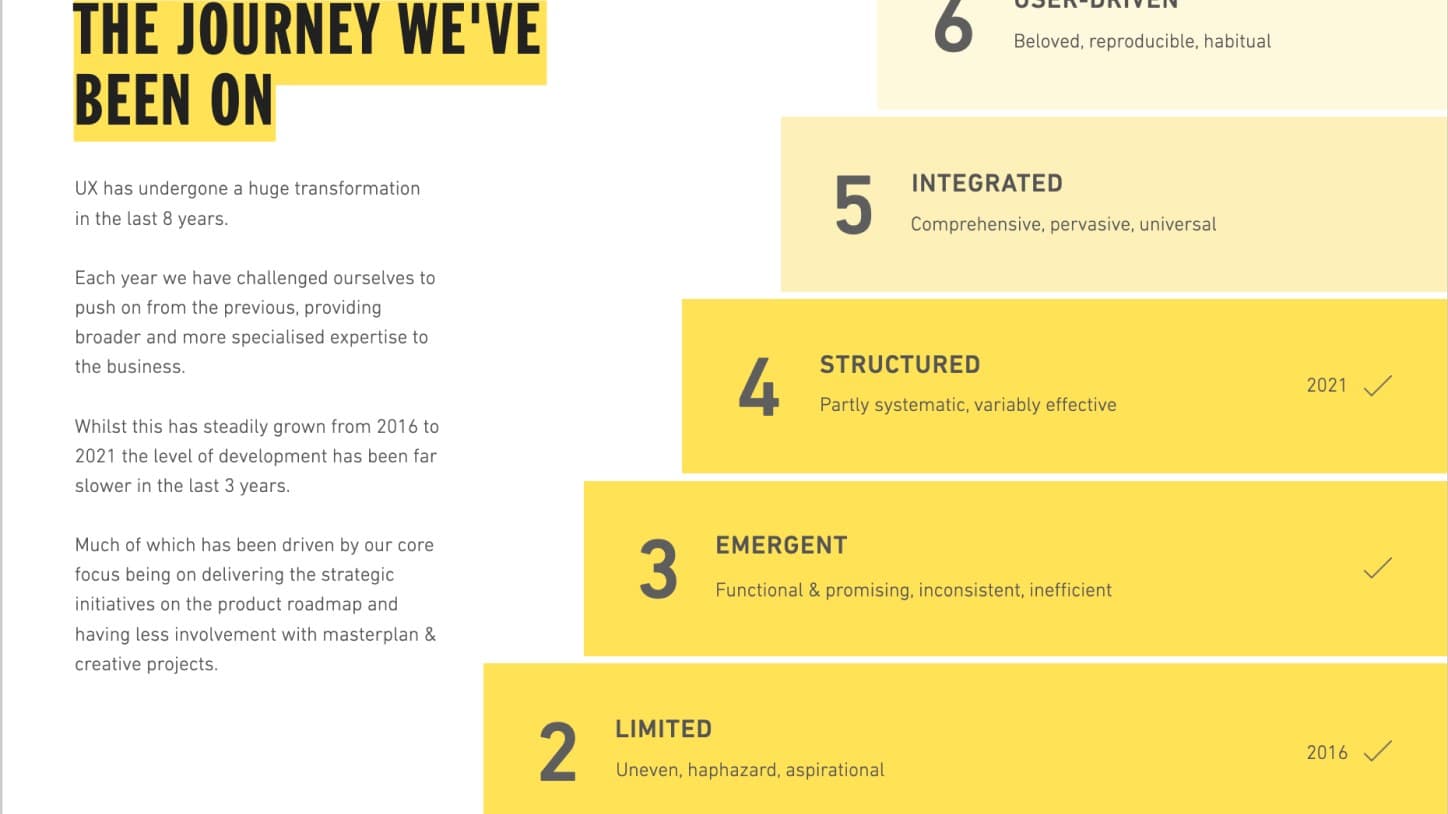
- Used a six-stage maturity scale, Absent, Limited, Emergent, Structured, Integrated and User-driven, to describe plainly where UX sat and where it needed to get to.
- Educated stakeholders through presentations, workshops and case studies, showing how research, testing and iteration connect to the numbers they already cared about.
- Introduced regular user testing and kept using the optimisation programme, so design choices were argued from real customer feedback instead of taste.
- Created personas and mapped customer journeys end to end, so teams outside design shared one understanding of who they were building for.
- Developed the Selfridges Design System, and wrote UX guidelines covering usability, accessibility and brand consistency.
- Built a working relationship between UX, Product and Engineering that took some of the friction out of handovers, and made design reviews and critiques a normal part of the week.
- Defined UX measures tied to conversion, customer satisfaction and engagement, then used analytics, heatmaps and session recordings to see what people did rather than what we hoped.
The outcome
UX stopped being a service that projects booked and became part of how digital work was planned. Research moved from occasional to regular, the design system gave Product, Technology and Creative something concrete to agree on, and reviews happened without me having to arrange them. On the six-stage scale the practice moved from limited in 2016 to structured by 2021. Integrated and user-driven are the two above that, and I wouldn't claim either. The top of that scale is probably always a bit further off than you'd like.
- Limited → Structured
- Movement on the six-stage maturity scale, 2016 to 2021
- Selective → continuous
- How user-centred thinking got applied
- Design system
- One standard shared by Product, Technology and Creative
What I learned
It took me a few years to accept that maturity doesn't come from doing better design. I assumed good work would speak for itself and the invitations would follow, and mostly they didn't. What actually shifted things was duller than that: sitting in other people's planning meetings, learning the measures they were judged on, and describing UX in language a commercial director already used.